In today’s fast-changing world, academic success requires much more than simply memorizing facts. Children need strong concentration, critical thinking, creativity, confidence, and problem-solving abilities to thrive in school and beyond.
While calculators and digital devices have made arithmetic easier, they have also reduced opportunities for children to strengthen their natural thinking abilities. This is where Abacus education makes a remarkable difference.
For centuries, the Abacus has been recognized as one of the most effective tools for developing mental calculation skills and enhancing whole-brain development. More than just a counting device, it trains children to think faster, visualize numbers, improve memory, and solve problems with confidence.
At Nimble Precise, we believe every child deserves the opportunity to unlock their full potential through structured learning that nurtures lifelong skills.
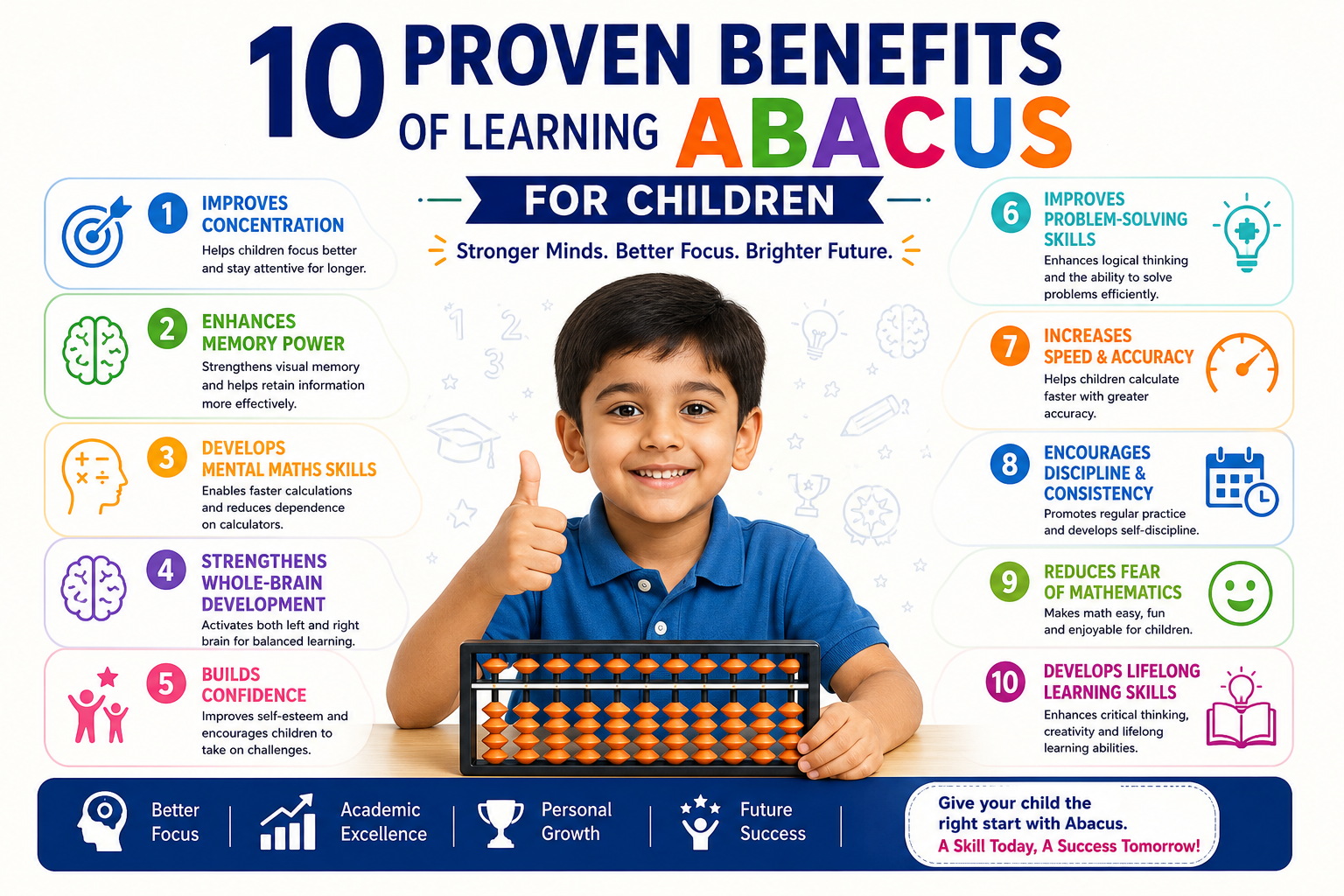
Let’s explore the 10 proven benefits of learning Abacus for children.
1. Improves Concentration
One of the first improvements parents notice is their child’s ability to concentrate for longer periods.
Abacus requires children to:
- Listen carefully
- Visualize numbers
- Move beads accurately
- Solve calculations quickly
This consistent practice strengthens attention span and reduces distractions.
Children who develop better concentration often perform more effectively across all school subjects.
2. Enhances Memory Power
Strong memory is essential for academic success.
Abacus encourages children to remember:
- Number sequences
- Mathematical operations
- Visual bead positions
- Mental images
These exercises improve both short-term and long-term memory, helping children retain information more effectively in school.
3. Develops Mental Maths Skills
Instead of relying on calculators, Abacus trains children to perform calculations mentally.
With regular practice, students can solve:
- Addition
- Subtraction
- Multiplication
- Division
with impressive speed and accuracy.
Mental maths builds confidence and reduces anxiety during examinations.
4. Strengthens Whole-Brain Development
The Abacus is unique because it engages both sides of the brain.
The left brain supports:
- Logic
- Analysis
- Mathematics
The right brain supports:
- Creativity
- Visualization
- Imagination
By combining both, children develop balanced thinking skills that benefit academics and everyday life.
5. Builds Confidence
Every correct calculation gives children a sense of achievement.
As they progress through structured levels, they become more willing to:
- Answer questions
- Participate in class
- Solve challenging problems
- Take on new learning opportunities
Confidence gained through Abacus often extends beyond mathematics into other areas of life.
6. Improves Problem-Solving Skills
Abacus encourages children to think systematically.
Rather than memorizing answers, they learn to:
- Analyze problems
- Choose appropriate methods
- Apply logical reasoning
- Arrive at accurate solutions
These skills prepare children for future academic and professional success.
7. Increases Speed and Accuracy
Academic success often depends on completing work efficiently.
Regular Abacus practice helps children:
- Calculate faster
- Reduce careless mistakes
- Improve numerical accuracy
- Complete assignments confidently
These improvements are especially valuable during school examinations and competitive tests.
8. Encourages Discipline and Consistency
Success in Abacus comes through regular practice.
Children naturally develop:
- Self-discipline
- Responsibility
- Patience
- Consistency
These habits become lifelong qualities that support success in every area of learning.
9. Reduces Fear of Mathematics
Many children struggle with mathematics because they lack confidence.
Abacus transforms mathematics into an enjoyable and engaging activity.
As children experience success, their fear gradually disappears and is replaced with curiosity and enthusiasm for learning.
This positive attitude often leads to improved academic performance.
10. Develops Lifelong Learning Skills
Perhaps the greatest benefit of Abacus extends beyond mathematics.
Children develop valuable life skills including:
- Critical thinking
- Decision-making
- Creativity
- Observation
- Listening
- Focus
- Confidence
- Perseverance
These abilities continue to benefit them throughout school, higher education, and future careers.
Why Parents Choose Nimble Precise
At Nimble Precise, we believe education should not simply prepare children for exams—it should prepare them for life.
Our structured Whole-Brain Development programs help students:
- Build strong mathematical foundations
- Improve concentration and memory
- Develop confidence and leadership
- Strengthen analytical thinking
- Enhance creativity
- Excel academically
- Acquire lifelong learning skills
Our experienced educators use proven teaching methodologies to ensure every child learns in a supportive, engaging, and enjoyable environment.
The Nimble Precise Difference
We don’t just teach children how to calculate.
We nurture learners who can:
- Think independently
- Solve problems confidently
- Communicate effectively
- Learn with enthusiasm
- Grow into capable future leaders
Every lesson is designed to empower children with the skills they need to succeed both inside and outside the classroom.
Final Thoughts
Abacus is far more than a mathematical tool. It is a powerful educational system that develops the mind, builds confidence, and prepares children for lifelong success.
When children learn Abacus through a structured program, they gain skills that extend well beyond numbers. They become more focused, confident, creative, and capable learners who are ready to embrace future challenges.
At Nimble Precise, our mission is simple:
Educate. Empower. Excel.
By nurturing young minds today, we are helping build a brighter, more confident generation for tomorrow.
Frequently Asked Questions (FAQ)
At what age should a child start learning Abacus?
Children can typically begin learning Abacus from the age of 5 to 7 years, depending on their readiness and ability to recognize numbers.
Does Abacus help with school mathematics?
Yes. Abacus strengthens number sense, mental calculation, concentration, and confidence, making school mathematics easier and more enjoyable.
How long does it take to see improvements?
Many parents notice improvements in concentration, confidence, and calculation speed within a few months of consistent practice.
Is Abacus only for children who are good at maths?
No. Abacus is designed for all children. It helps build confidence and understanding, especially for those who find mathematics challenging.
Why choose Nimble Precise?
Nimble Precise offers a structured learning system, experienced educators, personalized guidance, and a Whole-Brain Development approach that equips children with academic excellence and lifelong skills.
Ready to unlock your child’s true potential?
Join Nimble Precise and give your child the opportunity to develop confidence, concentration, mental agility, and lifelong learning skills through our internationally structured Abacus program.
Nimble Precise – Unleashing Genius with a Difference.